
The Beautiful and the Grim

There is something in our people that has never recoiled from the dim, the stern, or the half-veiled. Our forebears did not behold shadow as though it were some blemish upon the face of existence. They knew, with that older and quieter wisdom which belonged to them, that some of the deepest beauty is not found where all lies open in brightness, but where light is broken, where silence is heavy with meaning, and where life stands before man unsoftened and grave. This belongs to our inheritance. We are not a people sprung from ease, mildness, and abundance alone, but from dark forests, long winters, wind-beaten coasts, black waters, distant mountains, and that ancient nearness of a world at once beautiful, harsh, and immeasurably greater than ourselves.
This has shaped more than the outward conditions of our forefathers’ lives. It has entered their blood, their temper, their imagination, their inward bearing before the world, and through them it has entered ours. Our forebears did not merely dwell in this land; they were slowly wrought by it. They endured beneath its skies, were tested by its seasons, nourished by its gifts, chastened by its severity, and formed by its silence. Over generations beyond counting, the land inscribed itself into our people. And what shaped them did not perish with them. It continues in us still. Something of these forests, these waters, these distances, and these winters lives on within our very nerve, within our instinct, within that subtle folk-soul which the modern world scarcely knows how to name, yet which awakens within us when we stand before the dark wood, the still lake, or the mountain gathered beneath cloud.
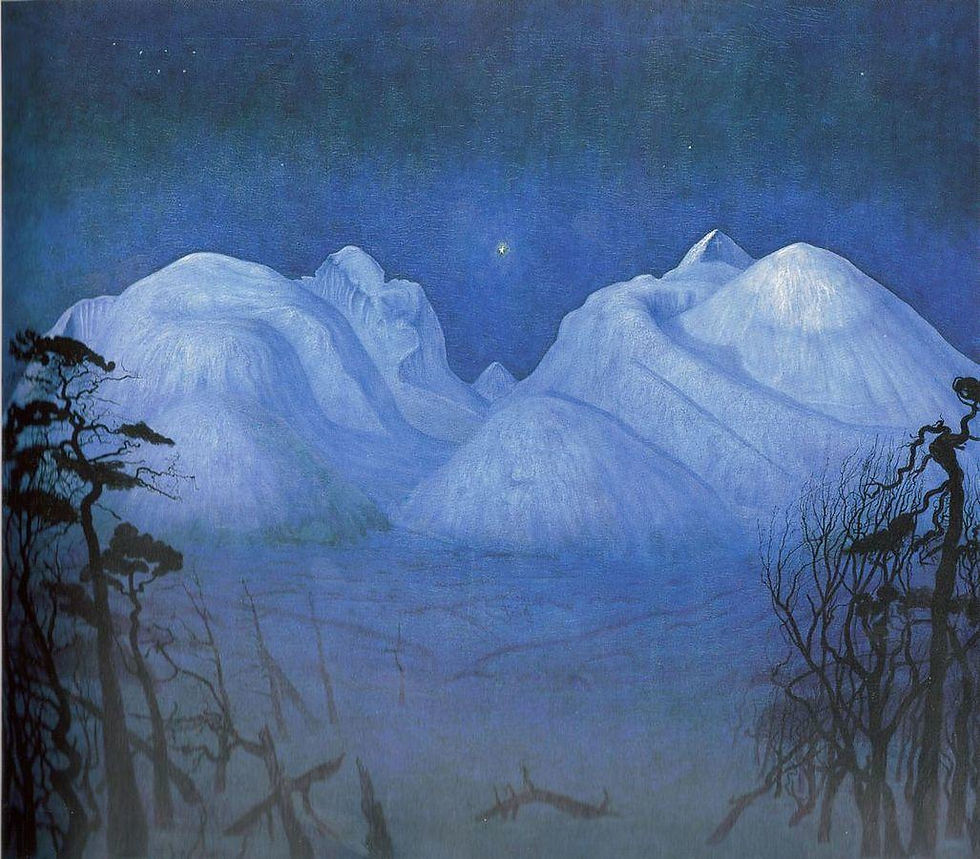
Vinternatt i Rondane by Harald Sohlberg
For this cause our people have so often discerned beauty where others have seen only gloom. We have never sought the beautiful solely in what is bright, sweet, and immediately pleasing to the senses. We have known another beauty, sterner and more enduring, which does not flatter but deepens, which does not soothe at once but enters slowly and takes hold of the inner man. It dwells in dusk, in mist, in weathered timber, in lonely roads, in the hush before snowfall, in sorrow borne upright, in the old tale that troubles as much as it consoles, and in those moments when the world seems at once withdrawn from us and yet more intimately present. Such beauty does not lie exposed upon the surface of things. It must be met inwardly, and for that very reason it abides.
Our forebears did not imagine life to be simple. Nor did they divide the world according to the thin and childish schemes by which modern man so often seeks to comfort himself. They knew that existence is woven of tensions that cannot be undone without falsehood: light and gloom, tenderness and severity, nearness and distance, awe and dread, growth and decay, beauty and danger. This, too, belongs to the subtlety of our folk-soul. We do not altogether trust what is thin, over-clarified, and neatly arranged for moral ease. Something in us knows that truth is older than comfort, and that life cannot be understood by stripping from it all darkness, all ambiguity, all sternness of aspect. One must look deeper. One must endure the complexity of things without fleeing into simplification.
This understanding lives with great force in the folktales of our people. Modern man often reads them poorly because he expects them to behave like lessons written for the reassurance of children. He seeks clear villains, spotless heroes, and endings that confirm his hunger for moral tidiness. But our old tales seldom proceed in such a fashion. They do not rest upon the shallow conceit that the world is divided into harmless good on one side and visible evil on the other. They speak rather of order, of consequence, of measure, of threshold, of what befalls the man who forgets the shape of the world and his place within it. In them, the forest is not evil, yet it may swallow him who enters it wrongly. The mountain is not malicious, yet it does not pardon arrogance and stupidity. The hidden beings are not always wicked in any final or absolute sense; they belong to another order, another rhythm, another law. If man approaches without reverence, he pays. If he comes with patience, courage, and right bearing, something may open unto him. Yes, the patterns of our fairy-tales are pagan science...
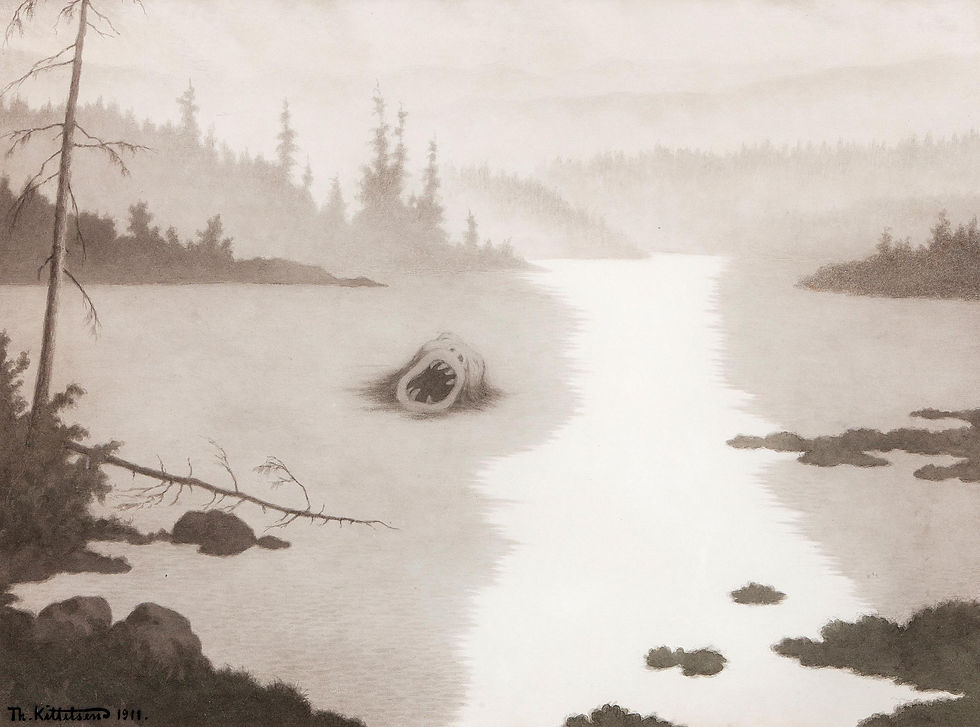
Nøkken by Theodor Kittelsen
This is no morality of abstraction. It is the morality of life itself. Our forebears knew that reality does not bow before human wishes. It has its seasons, its boundaries, its hidden laws, and its consequences. One overreaches, and one falls. One waits, listens, restrains oneself, and bears with steadiness, and then some deeper pattern begins to disclose itself. This is why our old stories yet feel true. They do not merely amuse. They remember something on our behalf. They carry that old Northern recognition that life is not governed by sentiment, but by order, by balance, by cycle, and by the grave necessity of right relation. They remind us that the world is not here to indulge us. It is here to be met worthily. Broken down to its pure essence, they are the laws of elements...
And perhaps for this reason the gloomy has always held such power over the imagination of our people. Not because our forebears delighted in darkness as such, but because the dim and the half-seen so often reveal a depth which full brightness conceals. In the half-light, the world is no longer reduced to use. It becomes presence. The black lake at evening, the marsh beneath a low sky, the stand of spruce breathing in stillness, the path that vanishes into mountain mist — these are not empty settings to our people. They are thresholds. They stir recollection. They awaken something ancestral. They remind us that the world is not exhausted by what may be measured, possessed, explained, or turned to advantage. Something in us answers to these things because something in us comes from the same order.
This same truth lives in the art of our people. What is deepest in it is seldom bright in any shallow sense. It does not adorn existence; it discloses it. It binds beauty to distance, to silence, to strangeness, to longing, to awe. The landscape is never merely background. It stands before man as presence, at times almost as witness, at times almost as judgment. The forest watches. The water conceals. The horizon calls. The mountain both withholds and beckons. Such images endure because they do not merely delight the eye. They touch memory. They stir something beneath taste. They remind us that we belong to a world older, larger, and more mysterious than our immediate desires.

Der lå Soria Moria slott by Theodor Kittelsen
This is why certain artists of our people have seen so deeply. They understood that shadow is not beauty’s enemy, but often one of its necessary conditions. They knew that what is half-revealed may move the soul more profoundly than what is wholly shown. A dark wood, a lonely dwelling beneath winter sky, a strange figure at the margin of the known, a silence so deep that it grows almost holy — these things bear a truth polished brightness cannot. They do not flatter man’s surface. They speak to what is oldest in him. They carry that peculiar union of sorrow and belonging, of eeriness and homecoming, which our people have always known in ways not easily explained, yet impossible not to feel.
The selfsame law abides in our music. Our people have never belonged wholly to sweetness. We are moved by what bears ache, grandeur, frost, solemnity, distance, and inward strength. Some of the deepest beauty in our inheritance does not console first. It deepens first. It opens something by way of severity. It may wound, and through that wound make room for a greater space within the soul. It may be rough in texture, yet nobly formed; dark in mood, yet radiant from within; harsh at the surface, yet ordered by discipline and hidden grace. This, too, belongs to the structure of our folk-soul. We have long known that beauty is not diminished by having passed through shadow. Often it is made greater thereby.
There is a deeper kinship between our folk music, the darker reaches of black metal, and the elevating force of classical music than many now understand. Outwardly they may seem far removed from one another, yet inwardly they often spring from the same ground. All of them, at their best, carry something of the same Northern nerve: longing, gravity, tension, distance, and the need to give form to what is deeply felt but not easily spoken. In the old folk tones we hear the weathered voice of our people, shaped by solitude, landscape, labor, and remembrance. In classical music, that same depth is given broader architecture and lifted into a more expansive order. And even in black metal, when it rises above mere harshness, one hear this same current moving beneath it: the same austere beauty, the same sorrow, the same force of atmosphere, the same will to shape darkness into something living, ordered, and strangely beautiful. Their forms differ, but the deeper pulse is actually one and the same.
Even the harsher expressions of our culture may, at their height, bear this same mark. Beneath roughness there may dwell order. Beneath force there may dwell intricacy. Beneath darkness there may dwell a beauty almost too deep for easy utterance. This is no contradiction. It is inheritance. The brutal and the beautiful are not always enemies in the world our forebears knew. At times they belong to one another. Severity protects beauty from becoming sentimental, while beauty saves severity from becoming barren. When these are joined in right measure, something unmistakably of our people appears: not softness, but depth; not sweetness, but greatness; not escape, but transfiguration.

Pesta i trappen by Theodor Kittelsen
Perhaps that is why our people have so often been drawn not merely to what pleases, but to what deepens. The dim, the weathered, the melancholy, the austere, the uncanny — these are not lesser forms of beauty to us. They are often the greater, because they have passed through reality and remained whole. They have borne sorrow, distance, danger, decline, and yet retained form. They do not deny the darker textures of existence. They gather them into a larger wholeness. They reveal that life is more demanding, more mysterious, and more beautiful than an age of comfort is willing to allow.
Our forebears did not seek to escape the great rhythms of being. They lived beneath them and within them. They knew the turning of seasons, the waxing and waning of light, the coming and going of life, the nearness of loss, the law of ripening and fading. They did not imagine that one might purify existence of such things without also emptying it of truth. Rather they sought to endure with dignity, to live in right relation to that which could not be mastered, and to discern within all passing things a deeper order. For that cause so much in our inheritance bears both chill and warmth, both gravity and wonder, both sorrow and strength. Beauty and Grimness. It reflects life as it is, not as a frightened spirit would have it be.
And perhaps this is why the old tale, the dim image, the lonely melody, and the half-lit landscape yet speak to us with such force. They do more than delight. They awaken remembrance. They restore proportion. They call us back into relation with that which formed us. They remind us that beauty is not merely what comforts, but what enlarges, steadies, chastens, and draws man nearer to that which endures. In this sense, the gloomy is not beautiful because darkness has become a taste or a fashion. It is beautiful because it bears the mark of truth. And something in our people still knows truth when it appears in that form.
This may be among the deepest intuitions of our folk-soul: that the world is most beautiful not when it is stripped of shadow, but when light is seen within it. We know this so instinctively because we ourselves were shaped in that meeting. Our people came forth from a land of mist, silence, distance, winter, danger, longing, and wonder. Our forebears were formed by it, and through them so were we. That is why the dim, the raw, the solemn, and the half-hidden do not feel foreign to us. They feel remembered. They feel as though they belong not only to the land of our forebears, but to something still living in our own depths. They feel, in the truest sense, like home.


